


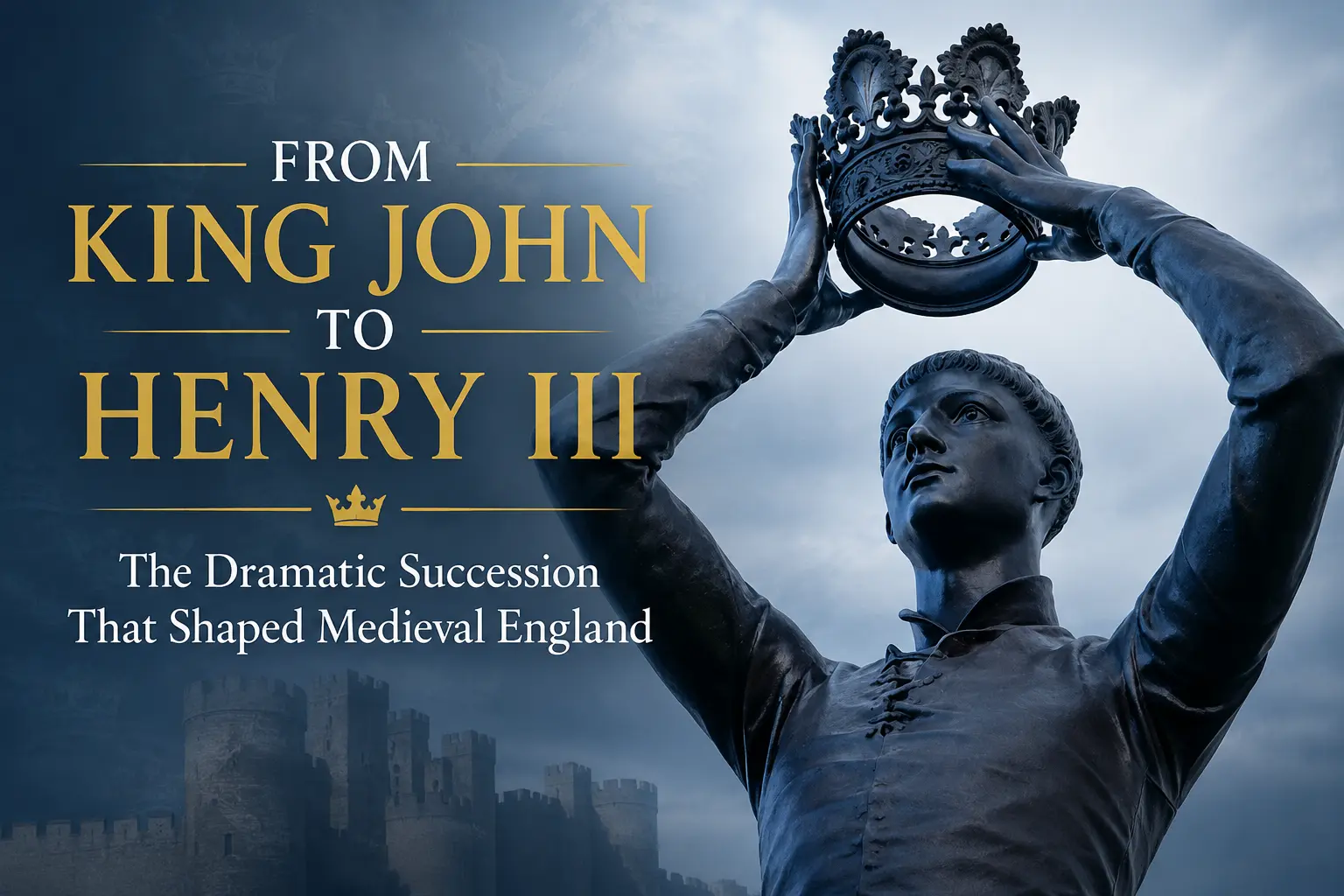
The death of King John in October 1216 marked one of the most dramatic turning points in English history. His reign had been overshadowed by rebellion, political instability, and military defeats, leaving the kingdom deeply divided. Yet his passing created an unexpected opportunity to reshape the future of medieval England through the accession of his young son, Henry.
At , I’m passionate about bringing these remarkable moments to life through meticulously researched historical fiction. The transition from King John to Henry III is one of the most compelling stories of the Middle Ages, filled with uncertainty, loyalty, and remarkable individuals whose actions altered the course of history.
This pivotal succession also provides the foundation for my upcoming Henry III trilogy, which explores the young king’s remarkable journey from vulnerable child monarch to one of England’s longest-reigning medieval kings.

Who Was Henry III When He Became King?
When Henry III became king, he was only nine years old. Dressed in oversized robes and crowned with his mothers crown in Gloucester. Unlike many medieval successions, there was no experienced adult monarch ready to take control. England was in the midst of civil war, with many powerful barons supporting Prince Louis of France as an alternative claimant to the English throne.
Henry had been born in Winchester in 1207, the eldest legitimate son of King John and Isabella D’Angouleme. Although he had been raised as the heir to the throne, few could have imagined that he would inherit such a fractured kingdom at such a young age.
Despite the uncertainty surrounding his succession, many nobles recognised that supporting the young Henry offered England its best chance for stability. His youth also allowed many former opponents of King John to separate their feelings about the father from their hopes for the son.
For readers who enjoy medieval historical fiction, this period offers everything that makes the genre so compelling: political intrigue, shifting alliances, determined leaders, and extraordinary courage in the face of overwhelming odds.
How Did Isabella D’Angouleme Influence Henry’s Claim?
Henry’s mother, Isabella D’Angouleme, played an important role in securing her son’s position, even if her influence was not always exercised directly within England. As queen consort, Isabella had endured the turbulent reign of King John and understood the dangers facing her young son after his father’s death. Although she would later return to her homeland in France, her royal lineage and status reinforced Henry’s legitimacy at a critical moment.
Medieval queens often influenced politics through diplomacy, family connections, and strategic alliances rather than commanding armies. Isabella’s position helped to strengthen Henry’s claim during a time when questions of legitimacy and hereditary succession mattered enormously.
Her story remains one of the fascinating threads surrounding Henry’s early reign, providing additional depth to a succession already filled with remarkable personalities and difficult decisions.
Why Did So Many People Support The Young King?
Following King John’s death, England desperately needed hope. Many barons had rebelled against John’s rule but were less willing to oppose an innocent child who represented a fresh beginning.
Supporting Henry allowed many nobles to reunite behind the Plantagenet dynasty without endorsing the policies that had made King John so unpopular. It was a practical and symbolic decision that gradually shifted momentum away from the invading French forces. This change in loyalty demonstrates one of the defining characteristics of medieval politics: personal relationships, honour, and reputation often carried as much weight as military strength.
These complex human motivations are exactly what I, as an author of medieval historical fiction, seek to capture in my novels; allowing my readers to experience history through the ambitions, fears, and choices of the people who lived it.
What Part Did William Marshal Play In The Succession?
No discussion of Henry III’s accession would be complete without William Marshal, one of the greatest knights of the medieval world.
Already celebrated for decades of loyal service to several English kings, William Marshal stepped forward during England’s moment of greatest uncertainty. His reputation for honour, military skill, and political wisdom made him uniquely qualified to help secure the young king’s future.
Recognising Henry as the rightful monarch, William Marshal became the leading figure protecting the kingdom during its most vulnerable period. His leadership reassured wavering nobles and encouraged many to return to the royal cause.
His victories against the supporters of Prince Louis would prove decisive in preserving the English crown for Henry. Although the full story of the regency deserves its own exploration, William Marshal’s actions ensured that England had the opportunity to rebuild under its rightful king.
Why Was Henry’s Coronation So Unusual?
Henry III’s first coronation differed greatly from those of most English monarchs. With London under hostile control, the ceremony took place in Gloucester Abbey rather than Westminster. Even the traditional crown jewels were unavailable, forcing organisers to
improvise with his mother, Isabella D’Angouleme’s, crown.
Despite these unusual circumstances, the coronation carried immense symbolic importance. It publicly confirmed Henry’s position as England’s rightful king and gave loyal supporters a figure around whom they could unite.
How Does This Lead Into The Regency?
Henry III’s accession solved one problem but revealed another. A nine-year-old king could not govern a kingdom still threatened by invasion and internal conflict.
Experienced nobles therefore assumed responsibility for protecting both the young monarch and the realm itself. Their efforts as a regency under William Marshal would shape England’s political future while allowing Henry the opportunity to grow into his role as king.
Why Are We Returning To Henry III’s Story?
At History Reimagined, I believe Henry III deserves far greater recognition than he often receives. Overshadowed by his father, King John, and his famous son Edward I, Henry’s own life was filled with challenges, triumphs, and defining moments that transformed medieval England.
That is why I’m delighted to be developing my upcoming Henry III trilogy. Building upon rigorous historical research, while embracing the immersive storytelling that defines my catalogue of historical fiction, these novels will explore the remarkable life of a young king who inherited a kingdom on the brink of collapse and faced extraordinary challenges from the very beginning of his reign.
For readers who enjoy authentic medieval historical fiction, my forthcoming trilogy will continue the story from Henry’s dramatic accession; exploring the people, politics, and personal struggles that shaped one of England's most fascinating monarchs. Henry III is due its pre-release in late 2026.