


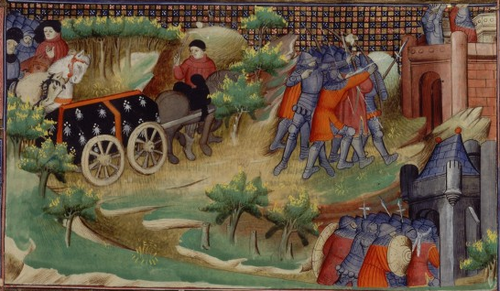
In medieval Europe, the death of a king rarely brought stability. More often, it triggered a desperate struggle for power. Castles were fortified, banners raised, and rival claimants sharpened their swords: not against foreign enemies, but against their own kin.
Succession wars became some of the bloodiest and most destructive conflicts of the Middle Ages, shaping kingdoms, dynasties, and the course of European history.
But why did so many medieval realms descend into chaos simply because a ruler died? The answer lies in a dangerous combination of uncertain inheritance laws, dynastic ambition, weak political structures, and opportunistic rivals.
The Problem of Unclear Succession Laws
Unlike modern monarchies, medieval kingdoms rarely operated under a single, universally accepted system of inheritance. Some regions followed primogeniture, where the eldest son inherited the throne. Others practised partible inheritance, dividing lands among sons: a recipe for fragmentation and rivalry.
One of the most famous examples came after the death of William the Conqueror, founder of the Norman Dynasty. Rather than passing all his lands to one heir, William divided his holdings between his surviving sons.
Robert Curthose inherited Normandy, while William Rufus became King of England. The division created immediate tensions between the brothers and weakened Norman unity for years afterwards: a conflict explored through the struggles of Robert Curthose in the Wayward Prince trilogy.
Succession customs also varied between kingdoms and evolved over time. When a ruler died, nobles and clergy frequently argued over which law or precedent should apply. These legal grey areas allowed multiple claimants to present themselves as the rightful ruler.
In medieval politics, inheritance law rarely settled disputes, but it often created them.
Too Many Heirs, Too Much Ambition
Royal families were large, and ambition was rarely in short supply. Kings often left behind legitimate sons, younger sons, daughters, nephews, cousins, and occasionally illegitimate children with powerful supporters.
Even when an heir had been officially named, rivals frequently believed:
- They possessed the stronger blood claim
- They were better suited to rule
- The chosen heir was too young, weak, or unpopular
In practice, medieval succession depended as much on military support as legal legitimacy. If a claimant could rally enough nobles, knights, and allies behind them, their claim became dangerously real.
This fierce competition for power lies at the heart of many works of Medieval historical fiction, where dynastic rivalries and divided loyalties create some of the most compelling stories in history.
Weak Central Authority
Medieval monarchs did not rule with the kind of centralised authority modern governments possess. Kings depended heavily upon the loyalty of powerful nobles who controlled their own lands, wealth, and armies.
When a monarch died, that fragile balance often collapsed.
During succession crises:
- Nobles supported whichever claimant promised greater privileges
- Alliances shifted rapidly as political fortunes changed
- Some lords used the chaos to expand their own influence or rebel outright
A child ruler or politically weak heir made matters even worse. Without strong leadership, rival factions could quickly plunge an entire kingdom into civil war.
These tensions would continue for centuries, contributing to later conflicts such as the wars of the Magna Carta, where disputes over royal authority and noble power once again threatened the stability of the English crown.
The Role of the Church
Religion added another layer of complexity to medieval succession disputes. The Church wielded enormous political influence and often played a decisive role in determining legitimacy.
Popes and bishops could influence succession through:
- Coronations and public endorsements
- Annulments of royal marriages
- Declarations regarding legitimate heirs
If a marriage was ruled invalid, an heir could suddenly lose their claim to the throne. Likewise, a rival claimant backed by the Church gained powerful moral authority.
In many cases, disputes over divine legitimacy escalated political tensions into open warfare.
Foreign Powers and Opportunism
Succession crises rarely remained domestic affairs for long. Rival kingdoms were quick to exploit instability in neighbouring realms.
Foreign rulers often:
- Funded rival claimants
- Supported heirs connected through marriage ties
- Invaded under the guise of ‘restoring order’ or defending legitimacy
What began as a family dispute could rapidly become an international conflict involving multiple kingdoms and dynasties.
The Norman world itself was shaped by these overlapping loyalties between England and continental Europe, particularly during the struggles involving Robert Curthose and his brothers following the death of William the Conqueror.
No Peaceful Transfer of Power
Perhaps the greatest reason succession wars were so common is also the simplest: Medieval Europe lacked reliable systems for peaceful transfers of power.
There were:
- No democratic elections
- No constitutional safeguards
- No neutral institutions capable of enforcing succession outcomes
Power passed through bloodlines, military strength, and political support. When those bloodlines became disputed, violence often decided the outcome.
The crown was not simply inherited: it had to be secured.
A Legacy Written in Blood
From the succession struggles of the Norman Dynasty, to the Wars of the Roses, medieval succession wars followed a familiar pattern: a dead king, competing heirs, ambitious nobles, and a kingdom pulled apart by divided loyalties.
These conflicts were not unusual accidents of history. They were the natural consequence of a world where laws were flexible, alliances fragile, and power depended upon force as much as legitimacy.
It is precisely this volatile world that continues to inspire the modern historical novels that I write, where rival dynasties, political intrigue, and personal ambition collide in dramatic fashion. Stories such as the Wayward Prince trilogy bring these historical tensions vividly to life, exploring the human cost behind the struggles that shaped medieval Britain and the wider Norman world.
In medieval Europe, succession was never guaranteed. It was contested, negotiated, and very often fought for on the battlefield.