
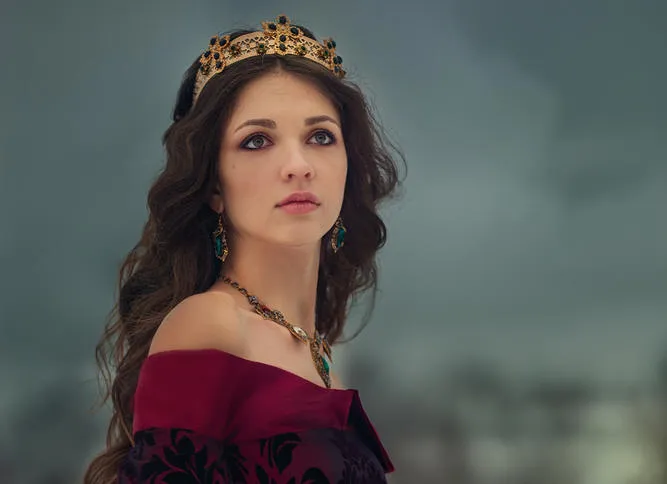
A heroine of history, Princess Berengaria of Navarre is taken from her homeland by the persuasive Eleanor of Aquitaine to marry her Crusade-bound son, Richard I, King of England, trying to catch and marry him turned out to be an unexpected adventure.
Shipwreck, and a attempted abduction are only a preamble to a disappointing wedding night, and worse is to come.
A sea battle, a bloody siege, a slaughter, and a husband more passionate about killing than married life sends the new Queen of England off to carve out a destiny of her own making.
Berengaria proves to be her own diplomatic champion and succeeds, despite the odds, to achieve the status of heroine, which she fully deserves.
Princess Berengaria of Navarre is often remembered simply as the wife of Richard I, the Lionheart. Yet her own story is far more interesting than that title suggests.
She was a young princess from Navarre, taken from her homeland by Eleanor of Aquitaine and brought towards a marriage with the crusading King Richard. What followed was anything but an ordinary royal wedding.
Her journey involved storms, shipwreck, danger and the threat of being taken hostage. Even after she finally married Richard, life as Queen of England was hardly the life she might have imagined.
Richard was a king obsessed with war. His attention was usually fixed on battlefields, castles and the Crusades rather than the woman he had married. Berengaria was left to face a very different kind of challenge: building a life and reputation of her own.
A Princess Chosen for a King
Berengaria was the daughter of Sancho VI, King of Navarre. Her marriage to Richard was not simply a romantic arrangement between two young royals.
Eleanor of Aquitaine saw advantages in the match. Navarre bordered the lands connected to the Angevin world, and an alliance with the kingdom could strengthen Richard’s position in southern Europe. The marriage also brought political and financial benefits at a time when Richard was preparing for the Third Crusade.
Eleanor personally travelled to bring Berengaria to Richard.
By the time Berengaria reached Sicily in 1191, Richard had already moved on towards the Holy Land. Instead of meeting her there, she had to continue the journey with Richard’s sister, Joan, Queen Dowager of Sicily.
The future Queen of England was already learning that royal life rarely followed a straight road.
Shipwreck on the Road to Richard
The journey became dangerous when the ship carrying Berengaria and Joan was driven towards Cyprus.
Their arrival did not bring safety.
The ruler of Cyprus, Isaac Komnenos, attempted to control the situation. Berengaria and Joan were reluctant to come ashore, fearing that they could be taken hostage. Their ship remained offshore while the political situation became increasingly dangerous.
Richard soon learned what had happened.
His response was not a diplomatic rescue party.
He invaded Cyprus.
Richard’s forces defeated Isaac and took control of the island. What had begun as a dangerous interruption to Berengaria’s journey became one of the major episodes of Richard’s route to the Crusade.
For Berengaria, however, there was finally one piece of good news.
She was about to become Queen.
A Wedding in Cyprus
On 12 May 1191, Richard and Berengaria were married at Limassol in Cyprus.
Berengaria was crowned queen on the same day. The wedding marked the beginning of a marriage that would become one of the more unusual royal relationships of the Middle Ages.
There was little time for a conventional honeymoon.
Richard had come to the eastern Mediterranean for war, and the Crusade demanded his attention. After their marriage, Berengaria travelled with Richard for part of the campaign before eventually being separated from him.
The queen had entered the marriage expecting a husband.
Instead, she had married a king whose greatest passion was warfare.
A Queen in the Shadow of a Crusader
Richard’s reputation was built on the battlefield.
During the Third Crusade, he fought at Acre, Arsuf and Jaffa and became one of the most celebrated military leaders of his generation. His successes made him famous, but they also reveal why Berengaria occupied such a difficult place in his life.
Richard spent little of his reign in England. Even after the Crusade, he remained heavily involved in military campaigns and struggles for his territories in France.
Berengaria, meanwhile, spent much of her married life away from him.
The contrast could hardly have been greater.
Richard became the legendary warrior king.
Berengaria had to find another way to matter.
When Marriage Was Not the Adventure She Expected
The romantic image of a princess marrying a famous king can make medieval marriage seem like the beginning of a fairy tale.
Berengaria’s experience was very different.
The surviving evidence gives us little reason to imagine a conventional married life. Richard spent very little time with his wife, and the couple had no children. Some later accounts have questioned whether their marriage was even fully consummated, although this remains uncertain.
What is much clearer is what happened afterwards.
Berengaria was not content to disappear into the background.
When Richard was captured on his journey home from the Crusade, she remained in Europe and became involved in efforts connected with his release. Richard’s captivity created a huge political and financial crisis, while Berengaria had to navigate a world in which her husband’s absence left her with little direct support.
Her story was no longer about catching up with Richard.
It was about finding her own place.
A Queen Without a King Beside Her
One of the most remarkable things about Berengaria’s life is how often she was physically separated from the man whose title she shared.
She did not become the powerful queen of England that later generations might imagine. Richard spent most of his reign abroad, and Berengaria never became a central figure in English political life in the way some medieval queens did.
Yet being overlooked by her husband did not mean that she had no influence or ambition.
Berengaria developed her own connections and interests. Later in life, she became closely associated with Le Mans and established the abbey of L’Épau, where she was eventually buried.
Her life after Richard’s death shows a woman who was capable of creating an identity beyond her marriage.
The Queen Who Survived the Lionheart
Richard died in 1199 after being wounded during the siege of the castle of Châlus in France. His death ended the reign of one of England’s most famous medieval kings.
For Berengaria, however, his death did not bring the end of her story.
She outlived Richard by more than three decades.
There was no great romance waiting for her at the end of the story, and there was no return to the life she might have imagined as a young princess in Navarre.
Instead, she built a life of her own.
That is perhaps the most interesting part of Berengaria’s history.
More Than the Wife of Richard the Lionheart
History has often remembered Berengaria through Richard.
She is introduced as his queen, his wife, or the princess he married before leaving for the Crusade. Her own achievements are much less familiar.
But Berengaria’s story deserves to stand independently.
She crossed Europe as a young princess, survived a dangerous journey, found herself caught up in the conquest of Cyprus, became Queen of England and then spent much of her married life separated from her husband.
She endured a royal marriage that gave her little of the companionship or influence that might have been expected.
And still, she created a life beyond it.
Berengaria was not a warrior like Richard. She did not lead armies across battlefields or become famous for conquest.
Her struggle was quieter.
She had to survive a world in which other people constantly made decisions about her future. In the end, she became more than the princess Eleanor carried across Europe and more than the wife of the Lionheart.
Berengaria of Navarre became the author of her own second act.
And perhaps that is why her story deserves to be remembered as the story of a heroine, rather than simply the queen who married Richard I.