


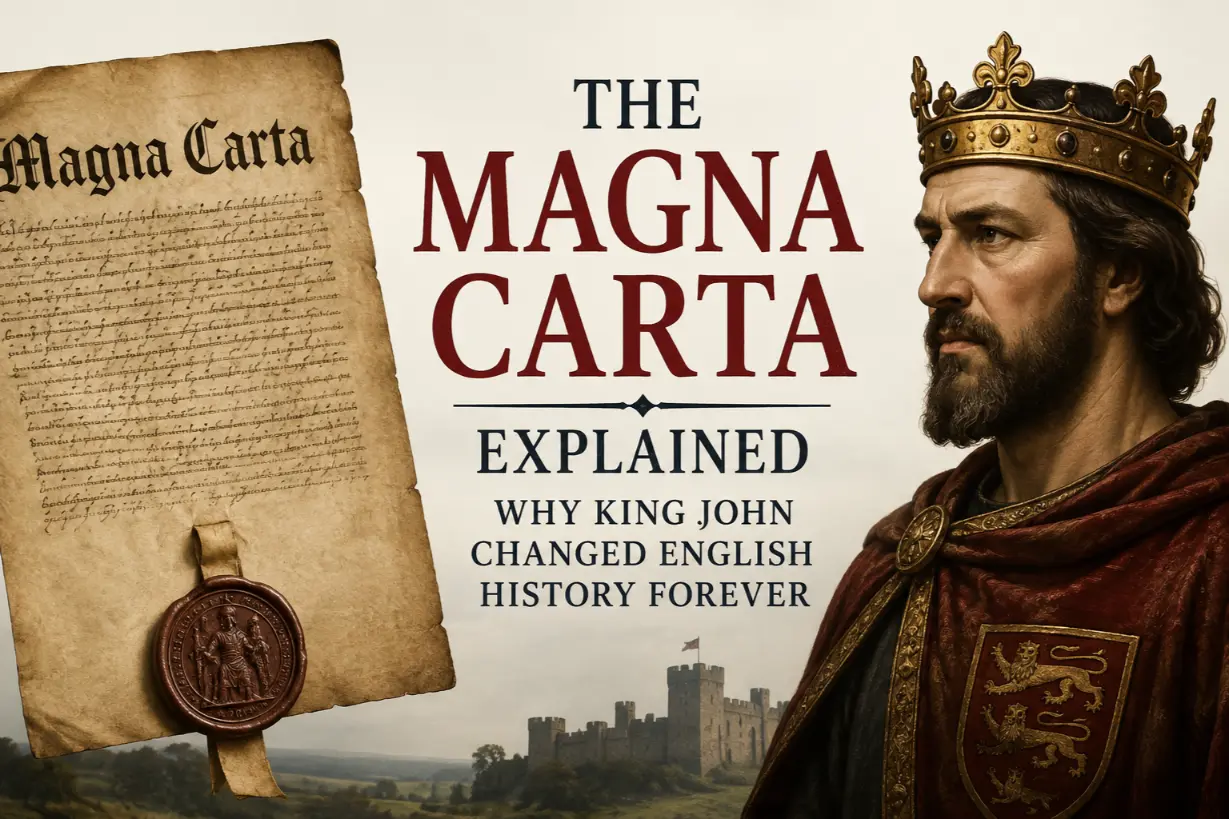
King John remains one of England’s most controversial monarchs. His reign was marked by military defeats, disputes with powerful nobles, heavy taxation, and growing unrest throughout the kingdom. Losing vast territories in France and clashing with both the Church and his own barons left his authority weakened. These tensions would ultimately lead to one of the most important moments in English history: the creation of the Magna Carta.
Throughout my King John historical fiction duology: The Wars of the Magna Carta: I’ve explored how the king’s complex personality shaped events that still influence the modern world: revealing the human stories hidden between the historical facts.

What Was The Magna Carta? A Brief History
The Magna Carta was not a single issue document, it had several iterations. It was first agreed at Runnymede in June 1215 after rebellious barons forced King John into negotiations. Rather than creating democracy overnight, it was intended as a peace settlement that addressed grievances against the King’s rule. It established that even the monarch should operate within agreed laws and customs instead of ruling entirely by personal will.
While many of its 63 clauses dealt with feudal matters of the time, the principle that the King could not simply act without restraint became its lasting legacy.
In 1217 King John’s son, Henry III, Revised the charter and included the separation of Forest Law. Under this law, a Forest was not necessarily an area of trees, but an area on a map designated as, ‘Forest.’ It often contained within its areas designated as, ‘Hunting Reserve.’ This issue was named, ‘The Charter of the Forests,’ and returned rights to folk normally resident within its boundary.
In 1225 the Magna Carta would be issued definitively when the king came of age: it is this version which became the basis for future confirmations. Until 1227 when Edward I made the final issue which entered the statute rolls, becoming law.
How Did The Magna Carta Restrict King John’s Power?
Before the Magna Carta, King John exercised his royal authority with very few practical limits. The charter sought to change that by placing restrictions on arbitrary taxation, protecting certain legal rights, and requiring the King to respect established customs. It also introduced a council of twenty-five barons who could ensure the charter was observed.
Although many clauses applied specifically to medieval society, the wider message was revolutionary: the Crown was expected to obey the law rather than stand above it. This principle would influence the English government for centuries to come.
Why Did The Magna Carta Lead To War?
Peace proved short-lived. King John never intended to accept lasting limits on his authority and quickly appealed to Pope Innocent III, who declared the Magna Carta invalid. The King’s rejection of the agreement reignited conflict, beginning what became known as the wars of the Magna Carta.
Rebel barons invited Prince Louis of France to claim the English throne, plunging the kingdom into civil war. Following King John’s death in 1216, his young son Henry III inherited a deeply divided realm, while loyalists led by William Marshal fought to preserve the English crown.
How Was The Magna Carta Finally Enforced?
The death of King John created an opportunity for reconciliation. William Marshal, a praised knight serving as regent for the young Henry III, reissued the Magna Carta in 1216 and again in 1217, removing some of the more controversial clauses while keeping its central principles intact.
These revised versions encouraged many former rebels to return their loyalty to the Crown. By ending the conflict and reaffirming the Magna Carta, it gradually became an accepted part of English law rather than simply a failed peace treaty.
How Do We Bring These Events To Life?
History becomes the most engaging when facts meet believable human stories. The Magna Carta historical fiction I’ve written: The Wars of the Magna Carta duology: combines extensive historical research with carefully imagined characters and conversations that bridge the gaps left by medieval chroniclers.
My aim is to remain faithful to the major historical events whilst exploring the personal motivations, fears, and ambitions of those who lived through one of England’s greatest constitutional crises: allowing readers to experience history through the eyes of those who shaped it.
What Can You Discover In Our Wars Of The Magna Carta Series?
The wars of the Magna Carta book duology follows the extraordinary events that unfolded after King John’s rejection of the Magna Carta. Rather than focusing solely on kings and famous knights, I’ve focused on bringing to life the personal stories of the remarkable individuals whose courage helped determine England’s future.
Book One: The Battle for England explores the rebellion that followed King John’s disastrous rule, featuring the determined defence of Lincoln Castle by Nicholaa de la Haye and the vital role played by Matilda of Laxton during England’s struggle for survival.
Book Two: A Contest of Wills continues the story after the lifting of the siege of Lincoln, following the challenges faced by medieval women determined to defend both their rights and their communities during the turbulent reign of King John’s successor, Henry III.
Why Read King John Historical Fiction?
History rarely divides neatly into heroes and villains. King John undoubtedly made decisions that fuelled rebellion, but understanding why those decisions were made offers a richer appreciation of the medieval world. Through my well-researched King John historical fiction, readers can experience the uncertainty, political intrigue, and personal conflicts that official records often overlook.
At History Reimagined, I believe history deserves to be questioned, explored, and experienced through compelling storytelling that remains firmly rooted in historical evidence. The wars of Magna Carta book duology invites readers to witness the battles, betrayals, and remarkable resilience that followed one of England’s most significant constitutional milestones, bringing the enduring legacy of the Magna Carta vividly to life.