
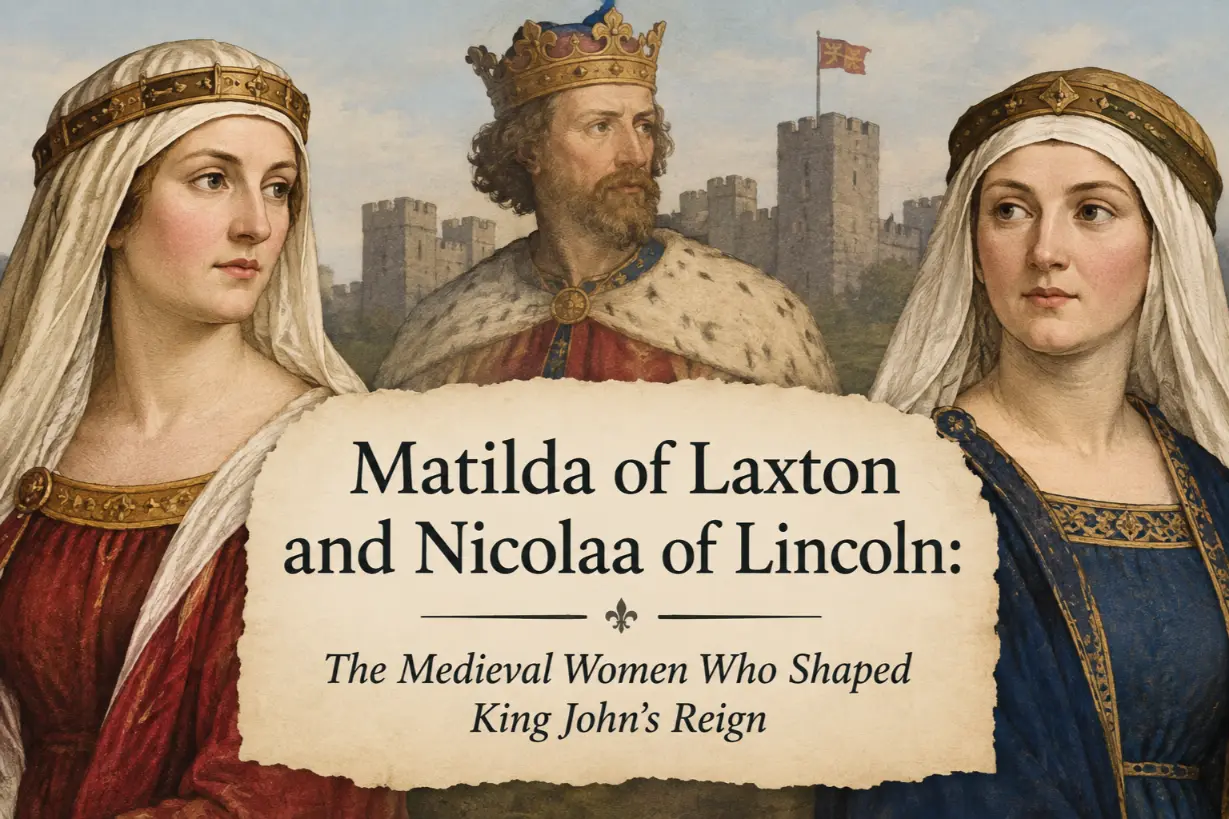
When people think of King John, they often picture the Magna Carta, rebellious barons, and political turmoil. Yet two remarkable women also played a significant role in shaping his reign: Matilda of Laxton and Nicolaa of Lincoln. Their stories reveal determination, resilience, and political skill during one of England’s most turbulent periods.
At History Reimagined, I believe history deserves to be experienced through the people who lived it. These extraordinary leaders demonstrate that women in medieval England were far from passive observers. They defended lands, managed estates, and influenced events that echoed across the kingdom.

Why Were The King’s Forests So Important?
The royal forests were far more than stretches of woodland. They represented wealth, law, and royal authority. Whoever controlled these lands controlled valuable resources, hunting rights, and local justice. The keepers of the King’s forests were entrusted with protecting the Crown’s interests, making their positions politically significant.
The conflicts involving Matilda of Laxton and Nicolaa of Lincoln unfolded against this backdrop. Their determination to protect inherited rights often placed them directly in the path of royal administration, forcing King John to balance loyalty, justice, and political necessity.
How Did Their Conflicts Help King John?
In many respects, the disputes surrounding these influential women strengthened the crown. Their willingness to uphold legal customs reinforced the importance of documented rights and feudal obligations. Resolving such disagreements allowed King John to demonstrate his royal authority whilst maintaining stability in strategically important regions.
Nicolaa of Lincoln, already renowned for her steadfast loyalty, proved herself indispensable. Her capable administration of Lincoln Castle and the surrounding lands ensured that one of England’s most vital strongholds remained secure during repeated unrest. Reliable supporters like Nicolaa gave the king valuable stability when powerful nobles questioned his rule.
Similarly, disputes connected with Matilda of Laxton highlighted the effectiveness of experienced local landholders in administering royal interests. While disagreements could be difficult, capable individuals ultimately strengthened the kingdom’s governance.
How Did Their Actions Also Create Difficulties?
The same determination that benefited the crown could also complicate royal government. Defending inherited rights often meant challenging officials, questioning decisions, or resisting changes imposed by the king’s administration. These legal battles consumed time, resources, and political capital.
This reflects a broader truth about when medieval women defended their rights. Noblewomen regularly pursued legal remedies, appealed royal decisions, and protected family inheritances. Far from accepting injustice, they used the legal system available to them with remarkable determination.
For King John, every dispute represented another delicate political calculation. Alienating loyal landholders risked weakening local authority, yet showing too much leniency could undermine the Crown’s power. These competing pressures became increasingly difficult as opposition to his rule intensified.
What Happened After The Forest Disputes?
The aftermath of these conflicts extended well beyond individual court cases. Questions surrounding land ownership, forest jurisdiction, and hereditary rights continued to influence relationships between the Crown and the nobility.
Nicolaa of Lincoln remained one of the king’s most trusted supporters. Her loyalty during the First Barons’ War became legendary as she successfully defended Lincoln Castle against rebel forces. Her steadfast service demonstrated that capable medieval women could exercise military and political leadership when circumstances demanded it.
Matilda’s legacy is equally as significant because her story illustrates how determined landholders could preserve family rights despite immense political pressure. Together, their experiences reveal the complexity of governance during King John’s troubled reign.
How Did These Women Influence Later Medieval History?
The tensions that emerged during these years did not disappear with King John. They continued to shape England under Henry III, whose reign saw the ongoing consequences of the Magna Carta, royal reform, and evolving relationships between the monarchy and the nobility.
Many of the legal principles defended during John’s reign became increasingly important under Henry III, as successive generations continued negotiating the balance between royal authority and inherited privilege. The experiences of Matilda and Nicolaa therefore form part of a much larger historical story.
Why Do These Stories Still Matter Today?
Historical figures like Matilda of Laxton and Nicolaa of Lincoln remind us that history is rarely shaped by kings alone. Courage, resilience, and determination often emerged from individuals whose contributions deserve far greater recognition.
At History Reimagined, my aim is to uncover these overlooked stories and present them through engaging, carefully researched historical writing. By combining meticulous research with compelling storytelling, I bring the medieval world vividly to life for readers who want to move beyond familiar historical narratives.
Whether exploring royal politics, forgotten personalities, or the everyday realities of medieval society, as an author, I strive to reveal the people behind the history rather than simply recounting dates and events.
Where Can You Discover The Rest Of Their Story?
The remarkable journeys of Matilda of Laxton and Nicolaa of Lincoln do not end with the forest disputes or even with the reign of King John. Their actions form a part of the wider political drama surrounding the Magna Carta, civil war, and the struggle for England’s future.
These fascinating events are explored in far greater depth through my Wars of the Magna Carta duology. The series follows the people whose lives were transformed by one of the most dramatic periods in English history, blending historical accuracy with immersive storytelling to reveal the human stories behind the conflict.
If the resilience of these remarkable women has captured your imagination, my Wars of the Magna Carta duology offers the perfect opportunity to continue their story and experience the extraordinary world they helped shape through courage, loyalty, and determination.