


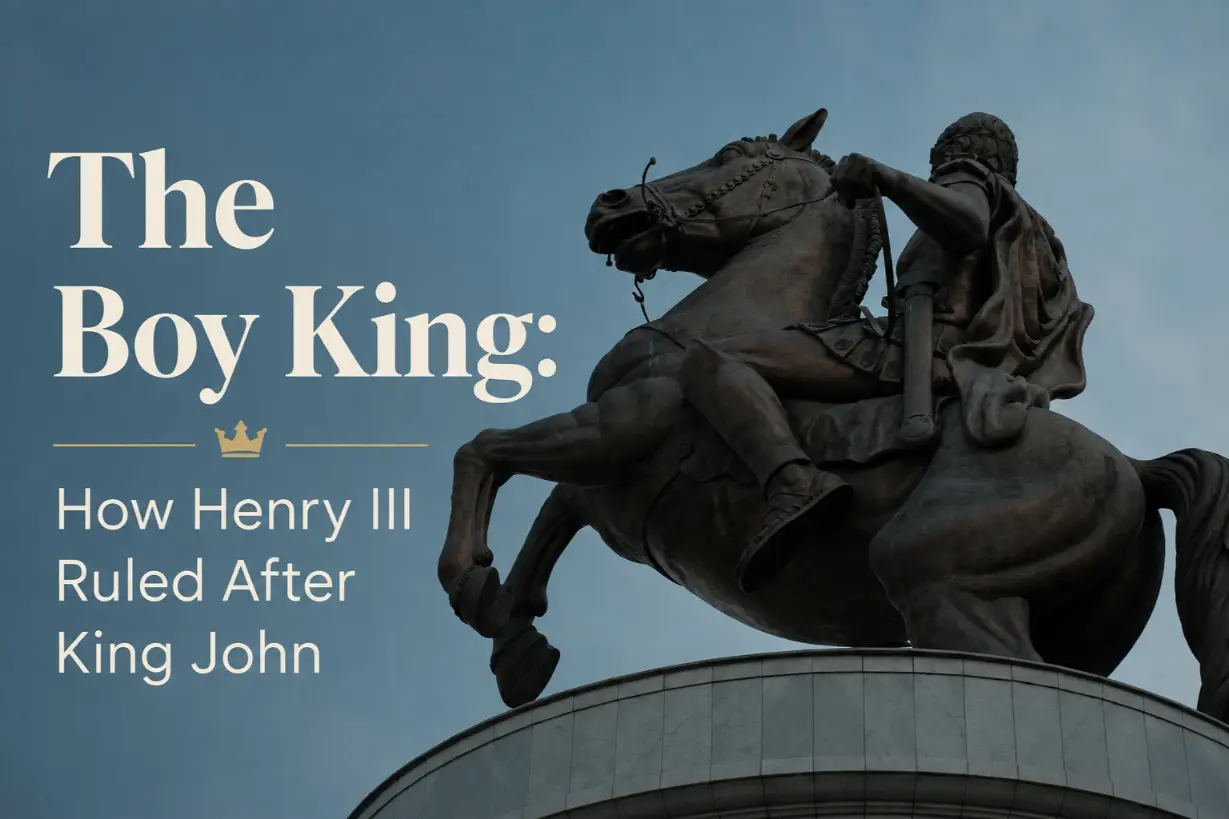
After King John’s death in 1216, his nine-year-old son, Henry III, inherited a kingdom on the brink of collapse. His reign would become one of the longest in English history, stretching for more than half a century and shaping the future of the English monarchy in ways that are still felt today.
At History Reimagined, I believe this extraordinary chapter deserves to be told with all the depth, drama, and authenticity it deserves. My upcoming Henry III trilogy explores the life of the young king from his uncertain beginnings, to the political storms that defined his reign.
Young Henry’s story has already been written and is expected to be released later this year as the opening instalment of the trilogy.

How Did Henry III Become King?
It’s hard to believe that Henry, at just nine years old, was expected to rule the uncertain climate his father left behind. Yet success and power were possible due to the unwavering leadership offered by William Marshal. Widely regarded as one of England’s greatest knights, William Marshal became Protector of the Realm following the death of King John. His experience, military skill, and unwavering loyalty allowed the young king’s government to survive during its most vulnerable years.
William Marshal rallied loyal supporters, defeated rebel forces, and secured victory against Prince Louis of France, preserving the Plantagenet dynasty. Without his leadership, Henry III may never have remained king.
My fascination with William Marshal has long inspired my writing, and readers in search of expertly researched William Marshal novels will enjoy the key contribution he plays in my upcoming retelling.
The transition between the eras of King John and his son King Henry III has provided some of the richest material for my historical fiction, allowing readers to experience history through the eyes of those who lived it.
Why Did Magna Carta Continue To Shape Henry’s Reign?
While the Magna Carta is closely associated with King John, its influence extended throughout Henry III’s reign. In fact, the young king’s government reissued Magna Carta several times to secure the loyalty of powerful barons and reinforce confidence in the Crown.
Rather than becoming a forgotten document, the Magna Carta evolved into a cornerstone of English governance: establishing expectations about the relationship between monarchs and subjects that continued to influence political life for generations.
Throughout my upcoming Henry III trilogy, readers will see how the Magna Carta remained far more than a historical document. It became a living political force that affected every major decision, alliance, and conflict during Henry’s lifetime.
Why Did The Barons Turn Against Henry III?
As Henry matured, many nobles grew frustrated with his style of government. His reliance on foreign advisers, expensive building projects, and perceived favouritism created increasing resentment among England’s leading barons.
These tensions eventually resulted in the Provisions of Oxford in 1258. This remarkable constitutional settlement sought to limit royal authority by placing greater power into the hands of a council of barons. It represented one of the earliest serious attempts to establish limits on the English monarchy beyond the Magna Carta itself.
The political manoeuvring surrounding these reforms forms one of the most compelling aspects of Henry’s reign. For readers who enjoy British historical fiction, it offers intrigue, shifting loyalties, and complex personalities whose motivations remain fascinating centuries later.
What Were The Provisions Of Oxford?
The Provisions of Oxford are still remembered today because they challenged the traditional balance of power between the king and his nobility. The reforms required Henry III to consult with elected councillors rather than ruling independently, while also introducing greater accountability within the royal government.
Although many of the reforms proved difficult to enforce, they demonstrated that English politics had entered a new phase. Kings could no longer assume unquestioned authority simply because of their birth.
Was Henry III A Successful King?
Should Henry III be remembered as a triumph or a failure? The answer is more complicated than either label allows.
Henry III achieved remarkable stability after surviving one of England’s greatest succession crises. He maintained his throne for over fifty years, promoted religion, commissioned magnificent architecture, including Westminster Abbey, and oversaw periods of peace and prosperity.
Simultaneously, his financial decisions, inconsistent leadership, and inability to manage ambitious nobles contributed directly to repeated political unrest. His reign revealed both the strengths and weaknesses of medieval kingship. It is precisely these contradictions that has made Henry such an engaging historical figure to write about.
Why Does Henry III Inspire Great Historical Fiction?
Henry’s story continues to captivate modern readers because it contains every element that makes historical fiction outstanding. There are courageous knights, determined queens, ambitious nobles, political conspiracies, civil war, family conflict, and the constant struggle between duty and personal conviction.
At History Reimagined, I am passionate about bringing these historical figures back to life through carefully researched storytelling. My novels blend historical accuracy with compelling narrative, allowing readers to experience historical events through the people who shaped them.
My upcoming Henry III trilogy explores these defining decades in far greater depth than a single article ever could. Young Henry’s story has been completed and is expected to be published later this year as the first instalment in an epic trilogy following his extraordinary journey from vulnerable child king to one of medieval England’s most complex monarchs.
For readers who love immersive British historical fiction, authentic medieval settings, and richly researched storytelling, my upcoming trilogy promises to offer an unforgettable journey through one of England’s most fascinating reigns.