


Among the most enduring stories surrounding King John is the tale of his alleged loss of the royal treasury in the treacherous marshlands of The Wash. Yet this famous incident was merely the final chapter in a lifetime marked by poor judgement, political miscalculations and military failures. Long before he became one of England’s most controversial monarchs, John had already established a reputation for losing opportunities, allies and territories.
His remarkable rise and troubled reign continue to inspire readers of British historical fiction and feature prominently in many acclaimed Plantagenet novels, where the dramatic events of the late twelfth and early thirteenth centuries are brought vividly to life.
The Youngest Son of a Powerful Dynasty
Born in 1166, John was the youngest son of King Henry II and the formidable Eleanor of Aquitaine, one of the most influential women of the Middle Ages. Unlike his elder brothers, John was not expected to inherit significant lands or titles. This earned him the nickname John Lackland, a reflection of both his limited prospects and the low expectations many held of him.
However, dynastic politics and unforeseen events would dramatically alter his destiny.
Regent During the Third Crusade
In 1190, John’s elder brother, King Richard I, took the cross and departed on the third crusade. Before leaving England, Richard appointed John as regent alongside their mother, Eleanor of Aquitaine, entrusting them with the governance of the kingdom during his absence.
Richard’s chief administrator, William Longchamp, Bishop of Ely and Justiciar of England, was expected to guide the inexperienced prince. Yet Richard’s confidence in his younger brother was limited. Should he fail to return from the Holy Land, Richard nominated his nephew, Arthur of Brittany, as his heir rather than John.
While Richard travelled south to join the crusading armies, Eleanor embarked upon a diplomatic mission of her own. She journeyed to Navarre to secure a bride for Richard, Princess Berengaria of Navarre. The marriage would strengthen the southern frontier of the Plantagenet domains and provide stability for the dynasty.
At this point, Eleanor stood at the centre of an empire stretching from the Scottish borders through England, Wales and Ireland, and across vast territories in France from Normandy to Aquitaine. Few rulers possessed such influence, and fewer still could match her political skill.
Fate intervened, however. Eleanor did not reunite with Richard until they reached Messina in Sicily. By then it was Easter, and Church law prohibited marriages during the holy season, delaying the wedding plans.
What Was John Doing?
While Eleanor was occupied abroad, troubling news emerged from England: John had fallen out with William Longchamp and alienated many of the kingdom’s leading barons. Reports of his behaviour became increasingly concerning. Eleanor abandoned her plans and returned to England to restore order, leaving Richard and Berengaria to resolve their marriage arrangements independently.
John’s conduct as regent reflected many of the flaws that would later define his kingship. Ambitious, impulsive and often self-serving, he quickly gained the distrust of many nobles. Rather than safeguarding his brother’s interests, he entered negotiations with Philip II of France, apparently believing Richard would never return.
His confidence grew further when news arrived that Richard had been captured while travelling home from the third crusade. The English king was imprisoned by Emperor Henry VI and held for an enormous ransom.
John and Philip attempted to exploit the situation by encouraging Richard’s continued imprisonment. Their efforts ultimately failed when Pope Celestine III intervened. Richard was eventually released after England raised a staggering ransom estimated at around 190,000 silver marks, an extraordinary financial burden for the kingdom.
Richard landed in England in March 1194.
Richard’s Forgiveness
Despite John’s actions, Eleanor of Aquitaine worked tirelessly to reconcile her sons. She persuaded Richard that John had been influenced by poor advisers rather than acting entirely of his own accord.
Richard accepted her counsel and forgave his younger brother. His attention then turned towards France, where he sought to recover territories lost during his captivity. Unfortunately, this campaign would prove fatal. In 1199, while besieging the relatively insignificant castle of Châlus-Chabrol, Richard was struck by a crossbow bolt. The wound became infected, and he died from sepsis on 6 April 1199.
His death transformed John’s fortunes.
King John Takes the Throne
With Richard gone and Arthur of Brittany unable to secure sufficient support, John became King of England.
For John, it was a triumph. For Eleanor of Aquitaine, it marked the beginning of a profound disappointment.
Throughout her life, Eleanor had worked to preserve the vast Angevin Empire built by her family. Under John’s rule, much of that achievement unravelled. He considered himself a capable diplomat and negotiator, yet his policies repeatedly produced disastrous results.
One by one, the Plantagenet possessions in France slipped from his grasp. Normandy, Anjou, Maine, Touraine, and other territories were lost through a combination of military defeats, political mistakes, and ineffective diplomacy. By 1204, the Angevin Empire had largely collapsed.
That same year, Eleanor died at Fontevraud Abbey. Many historians regard the loss of the continental empire as one of the greatest failures of John’s reign and a source of immense disappointment to his mother.
Berengaria’s Long Struggle
Another casualty of John’s rule was Berengaria of Navarre, Richard’s widow. As dowager Queen of England, Berengaria was entitled to substantial revenues and lands. John repeatedly withheld payments owed to her, forcing her into lengthy disputes with the English Crown.
She appealed to Pope Innocent III, Philip II of France, and numerous influential figures in an effort to recover her rightful income. The prolonged struggle revealed John’s willingness to ignore obligations when it suited his interests.
Growing Opposition
Meanwhile, the people of England faced increasing financial pressure.
John continuously demanded money to fund efforts to reclaim his lost French territories. Taxes rose, fines multiplied, and relations with both the nobility and the Church deteriorated.
His difficulties were compounded by disputes with Pope Innocent III over who should be the next Archbishop of Canterbury, leading to his excommunication in 1209-1213. Although he later reconciled with the Church, the damage to his reputation had already been done.
Many nobles who had lost lands in France blamed John directly for their misfortunes. Opposition to the king steadily grew.
Magna Carta and Rebellion
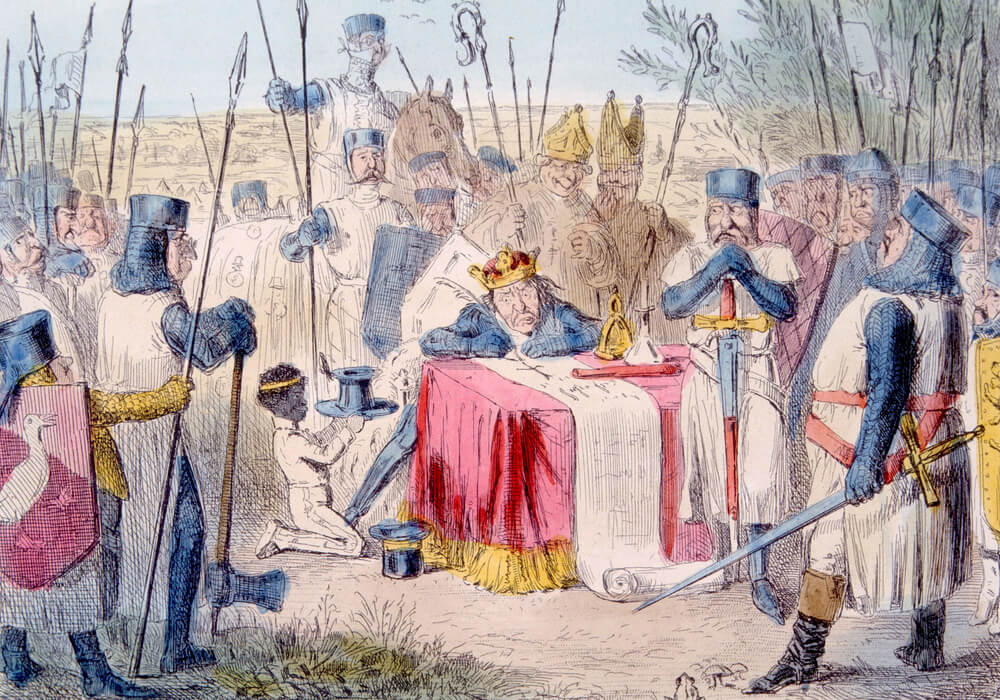
The mounting crisis culminated in 1215 when a coalition of barons forced John to accept the Magna Carta.
The charter sought to limit arbitrary royal power and establish certain legal protections for the kingdom’s leading subjects. Whether John fully understood its implications initially remains uncertain, but he quickly realised it restricted the authority he believed belonged to him as king.
Almost immediately, he sought to overturn the agreement. Appealing to Pope Innocent III, John secured papal support for his position and declared the charter invalid. His repudiation of Magna Carta plunged England into civil war.
These dramatic events form the backdrop to The Wars of the Magna Carta, a highly regarded series of King John historical fiction novels exploring the conflict that followed.
While firmly rooted in historical fact, the books bring to life the individuals whose courage and determination shaped England’s future.
The End of King John
As civil war intensified, Prince Louis landed in England and gained substantial support. On 2nd June 1216, many rebel barons proclaimed him king in Westminster, although he was never formally crowned.
John spent his final months moving across the kingdom attempting to regain control. In October 1216 he travelled through Lincoln before reaching Newark, where he fell ill. He died on 19 October 1216 at the age of forty-nine.
When news of John’s death reached Queen Isabella d’Angouleme she was with John’s son, Henry, in Corfe castle. She immediately rushed Henry up to Gloucester cathedral where he was crowned as Henry III in oversized robes and a queen’s crown.
She expected to gain control of Henry, and what was left of the Plantagenet empire. However, she was thwarted by a regency council led by the noble warrior, Willam Marshal, who helped form the nine year old Henry’s character in his early years. Isabella took the hump and went back to live in France, abandoning her son to his fate.
England’s position remained precarious. Large areas of the country remained under French control, and the kingdom’s future hung in the balance.
The decisive struggle would come in 1217, when the defence of Lincoln Castle and the leadership of William Marshal helped save England from becoming a possession of the French Crown.
These extraordinary events are explored in greater detail in The Wars of the Magna Carta, a series that combines meticulous research with compelling storytelling to recreate one of the most pivotal periods in English history.
A Legacy of Loss
King John’s reign is remembered for a succession of setbacks: the loss of French territories, conflict with the Church, rebellion among his barons, the civil war that nearly cost him his throne and, finally, the famous loss of his treasure in The Wash.
From overlooked prince to embattled king, John’s life was shaped by opportunities squandered and mistakes compounded. Yet his failures produced consequences that would outlive him. Through the Magna Carta and the struggles that followed, the foundations were laid for constitutional developments that would influence England for centuries to come.
It is little wonder that the dramatic story of King John, Eleanor of Aquitaine, the third crusade, and the conflicts surrounding The Wars of the Magna Carta continue to inspire readers of British historical fiction and Plantagenet novels today.